
Humanity has a superiority complex. It’s destroying the planet
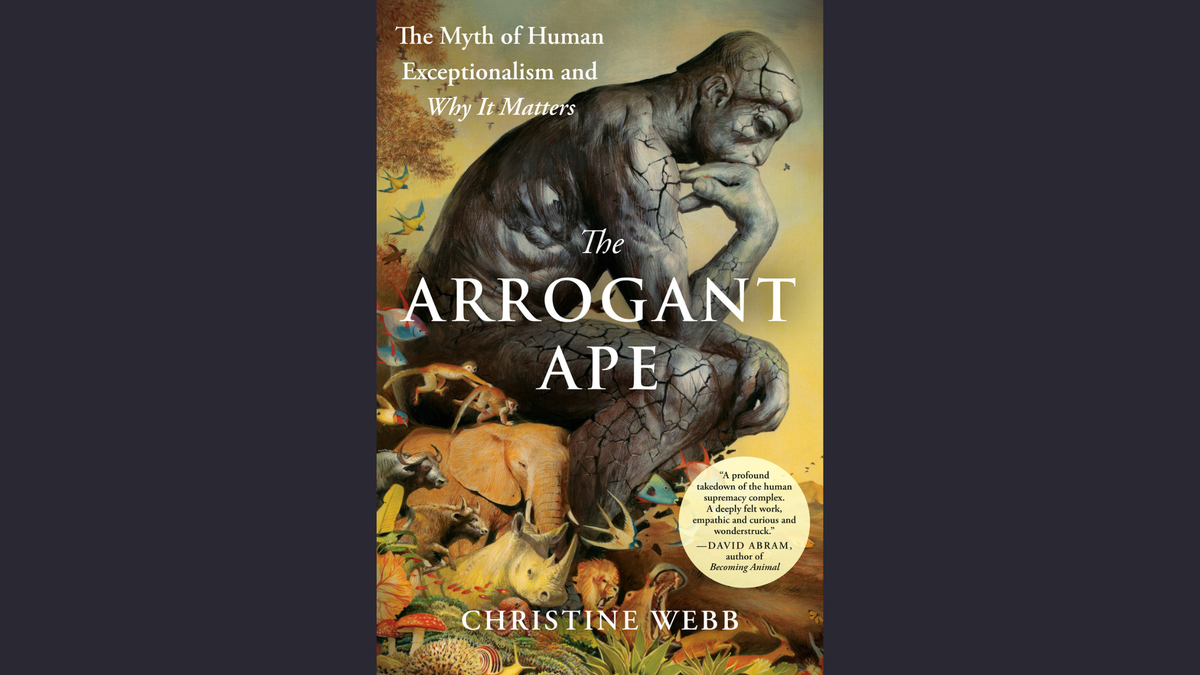
In her book The Arrogant Ape, Harvard primatologist Christine Webb details humanity’s superiority complex—and how it’s destroying our planet.
Written by Jack McGovan / Edited by Libby Langhorn
When Harvard primatologist Christine Webb dissected a frog in seventh grade, thousands of eggs spilled from her open corpse. She resisted thinking about the frog as a mother, unable to go on with the task at hand otherwise. As the lesson continued, she became more and more comfortable with the process of dissecting. It wasn’t until later in life that she realised the goal of that lesson wasn’t animal anatomy: it was to desensitise her to the idea that animals are beings to be cut open and studied.
The anecdote comes from Webb’s book The Arrogant Ape, published in September last year, which examines humanity’s superiority complex—our species’ belief that we are better and separate from the rest of the natural world. The book argues that this superiority complex is standing in the way of us solving systemic issues like the climate or ecological crises, and the only path to salvation for our species is to overcome it. Never has a message been so refreshing, timely, or necessary; it’s exciting to finally find a coherent theory that maps out how the struggles of all beings on Earth are interconnected.
Let us focus on the irrefutable evidence for a moment. Animal agriculture is the leading cause of deforestation worldwide, is responsible for around 20 percent of global emissions, and leads to massive amounts of pollution that is killing our rivers. It’s also an industry that is entirely based on human dominion over animals. Slaughterhouses, in fact, were the blueprint for the mass production of goods under capitalism. Human supremacy and the climate crisis are intertwined on these facts alone.
 Jack McGovan
The beauty of The Arrogant Ape is that it doesn’t linger too long on these technical details, and instead builds a theory based around a sense of awe for the world that we live in. Rather than thinking about animals as beings to which we have a moral obligation to treat right, Webb argues that we’d be better off thinking about what we as a species have to gain from shedding our supposed superiority: a sense of belonging to the natural world.
While not all of us have dissected animals in school, we’ve all undergone a process of conditioning in which we’re taught that other animals are lesser beings. An experiment highlighted in the book, for example, found that children were considerably less likely than adults to prioritise human lives over those of other animals, indicating that the belief that humans are innately special and more valuable isn’t instinct but socially acquired.
Intelligence is how we justify our superiority, but as Webb masterfully lays out, the way we measure it is flawed. Dogs navigate the world through their sense of smell, yet 74 percent of studies on dogs focused on vision—the predominant sense used by humans. If we’re measuring other animals by the parameters of the human experience, then of course they are going to fall short.
"A dog can never tell you what she knows from the smells of the world, but you know, watching her, that you know almost nothing." — a quote from poet Mary Oliver, featured in The Arrogant Ape
Webb highlights her own journey of overcoming human exceptionalism. Earlier in her career, she worked with captive chimpanzees, something which now weighs heavily on her heart. Not only do the animals suffer in this environment, the results of the experiments don’t necessarily reflect how those prisoners behave in the wild when they’re free and surrounded by other members of their species. Bad science, bad ethics.
It’s around the point of researching wild animals that I wanted a little more exploration from The Arrogant Ape. Many of the methods that researchers use to study wild animals harm the animals themselves—for example, an animal tagged with a GPS tracking device is more likely to die than an untagged animal. I’d have enjoyed more of a reckoning on the future of scientific pursuit as it relates to wild animals, particularly from someone whose career is centred on it.
The idea that humans are superior and separate from nature is why we’re chasing technological solutions to the climate crisis like solar geoengineering and colonising Mars, writes Webb—we view ourselves as so detached from the Earth that we’re willing to leave it. She urges us to discard this narrative of human supremacy before it’s too late, and to instead recognise that we can no longer rely on the values, institutions, and scientific methods that got us in this mess in the first place.
A look into Indigenous cultures in the book offers a way forward. Such cultures view themselves as a part of nature, and that respect for other beings is reflected in their language. Where 70 percent of words in English are nouns, the same proportion are verbs in Potawatomi. Where English speakers see a fox, the Potawatomi describe what it is to be a fox; a static thing versus a dynamic being.
“When you perceive the world as an object, its destruction becomes meaningless.” — Christine Webb, The Arrogant Ape
Since the 1800s, there has been a sharp decline in nature-related words used in English language books. Rather than speaking about nature through poetic language that imbues a sense of wonder about the non-human world, we instead use words like timber or freshwater. We talk about nature in relation to human consumption, meaningless objects that only exist to be used by us.
Webb paints a convincing picture that the only way forward for humanity is to start building new cultural narratives that have us as a part of nature, not separate from it. Where I very much agree with her is that this change is not going to come from a top-down approach alone, from flawed institutions that uphold the current system, but rather from people like you and me who are motivated by a new vision for the future.
Only by letting go of our ego as a species and becoming more humble are we ever going to get out of this mess that we ourselves have created. We don't need narratives of human supremacy and our own importance to give meaning to our lives. We're special simply because we exist, and that holds true for all of the other species with which we share this wonderful planet.
Comments ()