
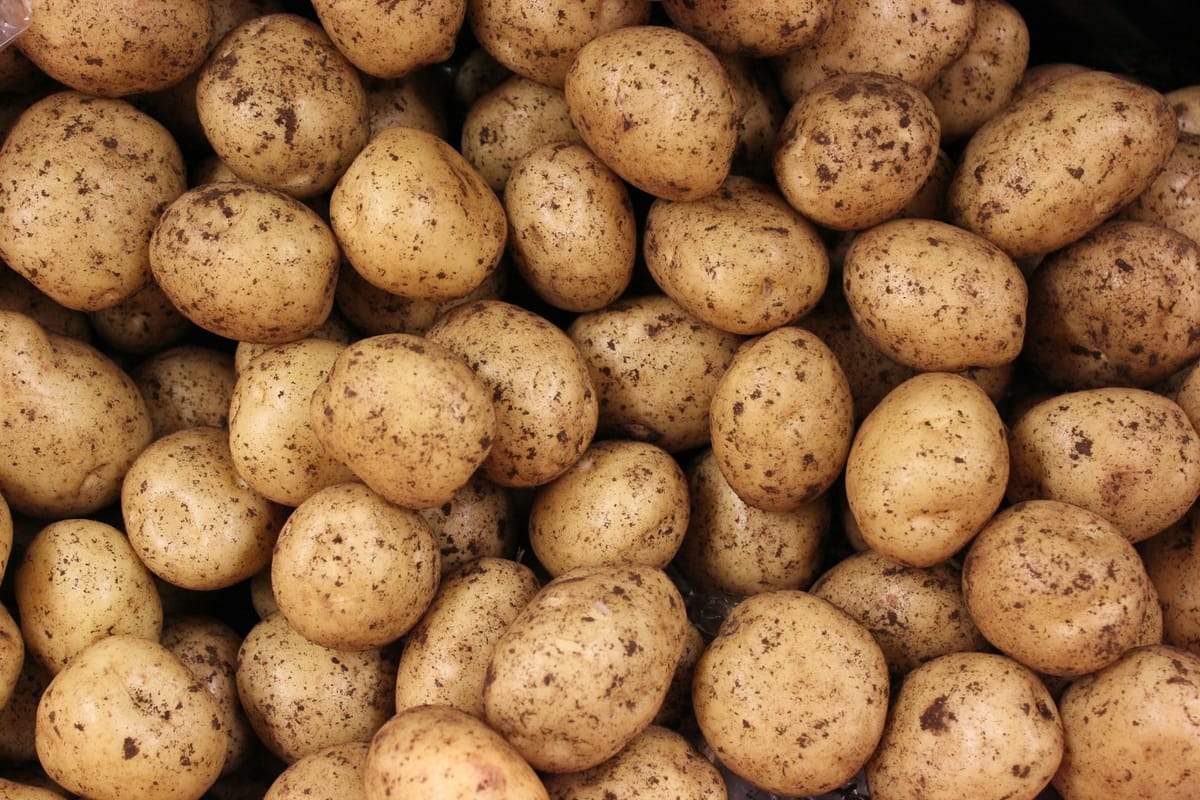
Did Berlin really save 4000 tonnes of potatoes from the bin?
An initiative is distributing free potatoes around the city of Berlin, yet some say it’s more PR stunt than practical solution.
Written by Jack McGovan / Edited by Libby Langhorn
On a street corner in Baumschulenweg, Berlin, neighbours gathered together in the middle of January despite the cold to listen to music, drink some glühwein, and share some potatoes. Lindsey Elms attended the event—a distribution point for free potatoes through the 4000 Tonnen (4000 Tonnes) initiative—for social reasons, though she noticed all of the potatoes were gone by the time she arrived. “I wanted to check out the event and planned to fill a bag for some older neighbours,” said Elms.
Many people like Elms braved the cold and icy conditions in recent weeks to score some free potatoes to help see them through the coldest January in 16 years. Demand has been high: one pick-up point saw two tonnes of the staple vegetable taken in 25 minutes, disappointing stragglers—including your esteemed reporter—who showed up hours later.
The 4000 Tonnen initiative is a joint venture between the farm Osterland Agrar, search engine Ecosia, and newspaper Berliner Morgenpost. Due to an overproduction of potatoes in the German market this year, Osterland Agrar had 4000 tonnes of potatoes in storage with nowhere to go. Ecosia, who reached out to Berliner Morgenpost to organise the initiative, paid for the transport of the potatoes to Berlin. An update from 7 February on the initiative’s website stated that this week’s distribution has been sponsored by renewable energy company GASAG.
Food waste is a massive issue facing the world today. Roughly one third of all food produced for human consumption is wasted, at a time when almost 33 million people in the EU—roughly 7.3% of the population—can’t afford a meal every second day. Producing food that is then wasted means wasting all of the resources used to grow it, too: water, fertilisers, pesticides, and energy to operate machinery, among others.
A “marketing action” distracting from the real issue
Despite the warm reception to free potatoes from Berliners, however, some people have a frostier view of the situation. Jan Greve, spokesperson for food systems change alliance Wir haben es satt! (We’re fed up!), called it a “marketing action” by Ecosia and Berliner Morgenpost, whose positive spin prevented a reckoning with the underlying issues that caused this surplus in the first place. “Behind it all there’s a huge problem that won’t be solved through such a singular initiative,” he said.
The problem, Greve highlighted, is that farmers are forced to react to short-term fluctuations in prices. A couple of years ago, potato prices were high and farmers responded by choosing to grow more potatoes. Due to good harvests in recent years, however, the country has now been left with a surplus; mountains of potatoes that are perfectly edible yet unwanted by the market. “The volatility of the market is really problematic for farmers, and it means they can’t plan for the long term,” said Greve.
Although Greve initially saw 4000 Tonnen in a positive light, he soon changed his opinion after seeing a video posted by regional farmer Johann Gerdes on Instagram. Gerdes argued that because the surplus potatoes had come from a different region of Germany, they would lower demand for potatoes from local farmers, therefore leaving a lasting impact on the local market.
Johannes Schuler, an agricultural engineer studying the economic effects of agricultural policy at the Leibniz Centre for Agricultural Landscape Research (ZALF), told Sower that an influx of potatoes like this “can have a real effect” on the market because people could now stop buying potatoes. “I don't assume bad intentions,” he said. “But I think with the sheer amount, they were not aware of the fact that they might also do some harm to other farmers.”
An important part of the giveaway is that the potatoes themselves had already been paid for. Potatoes are delicate, explained Schuler, and so they’re typically produced under contract for a big manufacturer or distributor i.e to make crisps or to sell in supermarket chains. Due to the overproduction of potatoes this year, however, the company who ordered the 4000 tonnes simply decided not to pick them up. “It's not that the farmer was sitting on his potatoes and now [he’s] almost bankrupt,” he said.
Only 200 tonnes actually distributed so far
Alongside the impacts on markets, there’s a question of how many potatoes were actually saved. According to the 4000 Tonnen website, only around 200 tonnes of the potatoes have actually been distributed. Schuler said that potatoes need to be stored properly, which typically isn’t possible in an average apartment. “The food waste might then not happen at the farm level, but… now in households because people were maybe too greedy,” he said.
Households in the EU are responsible for 53 percent of food waste, followed by 19 percent in manufacturing, and 10 percent at the farm level. The EU has adopted legally binding targets to reduce food waste by 2030. Alongside reducing waste by 10 percent in manufacturing, the bloc aims to cut waste by 30 percent across retail, restaurants, food services, and households.
Elms was given some potatoes from a friend of hers who had gone to a different pick-up point in Görlitzer Park. He told her that he was “amazed” by the large size of the containers people were bringing to collect the potatoes—whole bike bigs filled to the brim. He also admitted that he only stopped himself from taking more than he had because of the long line of people behind him.
The rush around 4000 Tonnen left little space for community building, said Elms, who organised a distribution table of rescued food for two years as part of a community garden she launched during lockdown. “I witnessed how rescuing food had such a positive impact on building connections and directly helping those of us on tight budgets,” she said.
The 4000 Tonnen initiative, on the other hand, was more of a free-for-all with even people on high incomes trying to get some potatoes. It got her asking a question to which she hasn’t necessarily found the answer to: “Why were the demographics of the people that showed up so much more diverse than those people who participated in the garden’s rescued food project?”
More financial stability for farmers needed
What, then, could be done to stop this kind of thing from happening in the future? Felix Zoll, a researcher studying alternative methods of food production at ZALF, suggested that community supported agriculture (CSA) is one way of preventing food waste at the farm level. Farmers following a CSA model will produce a given amount of food per year and share it fairly among those who pay a monthly subscription. “If it's a good year, they will get a bigger share,” he said. “If it's a bad year, they will get less produce.”
Although, he said, that it’s unrealistic that every farm in Germany would follow the CSA model, it offers a lot of ideas on solidarity with farmers. Not only does a guaranteed income give farmers more economic stability, consumers have a direct link to the farmers and are often invited to work on the farms for a couple of days. That helps to build bridges which have broken down in recent times. “There's more trust in agriculture if there are direct connections between producers and consumers,” he said.
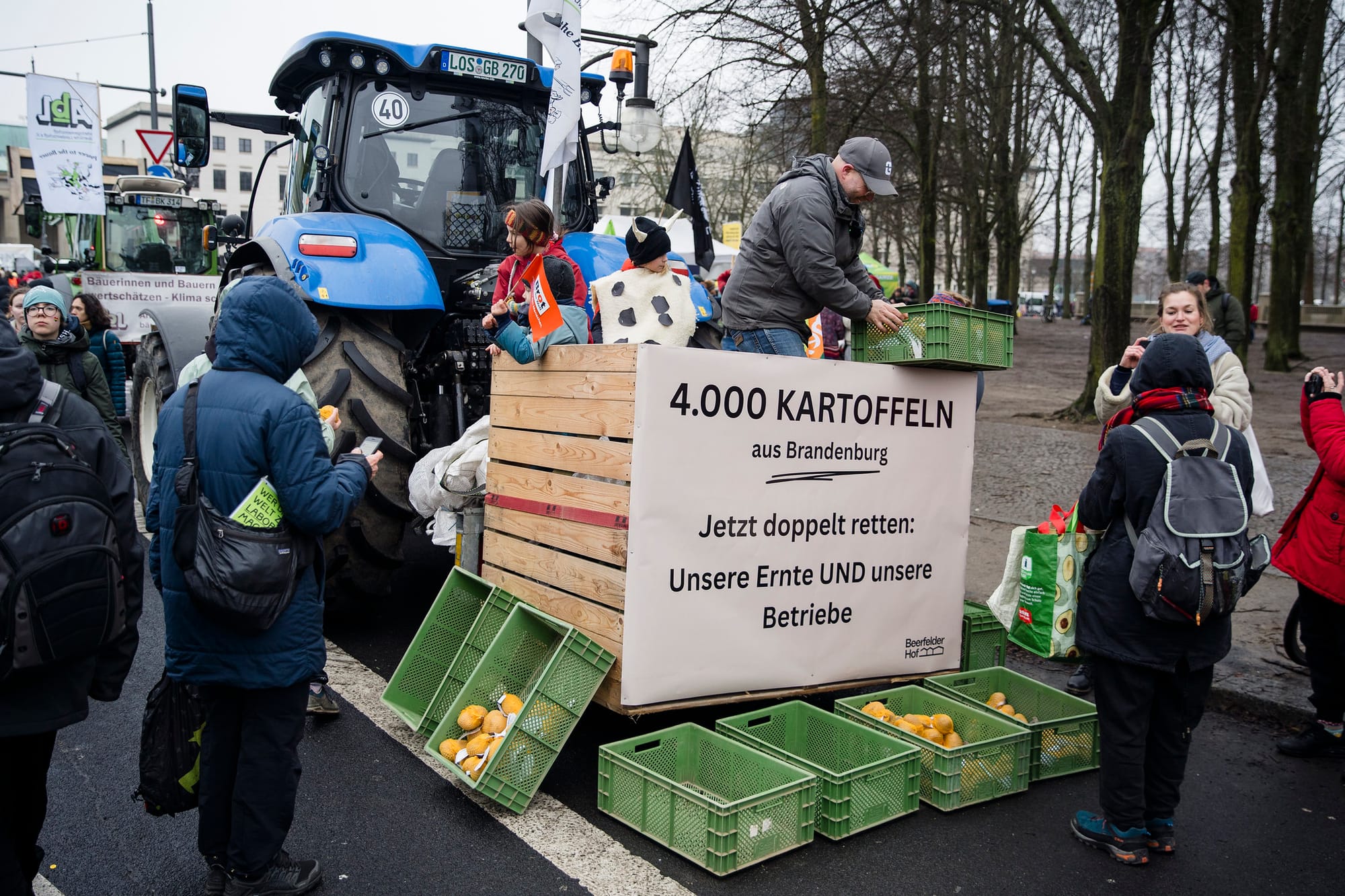
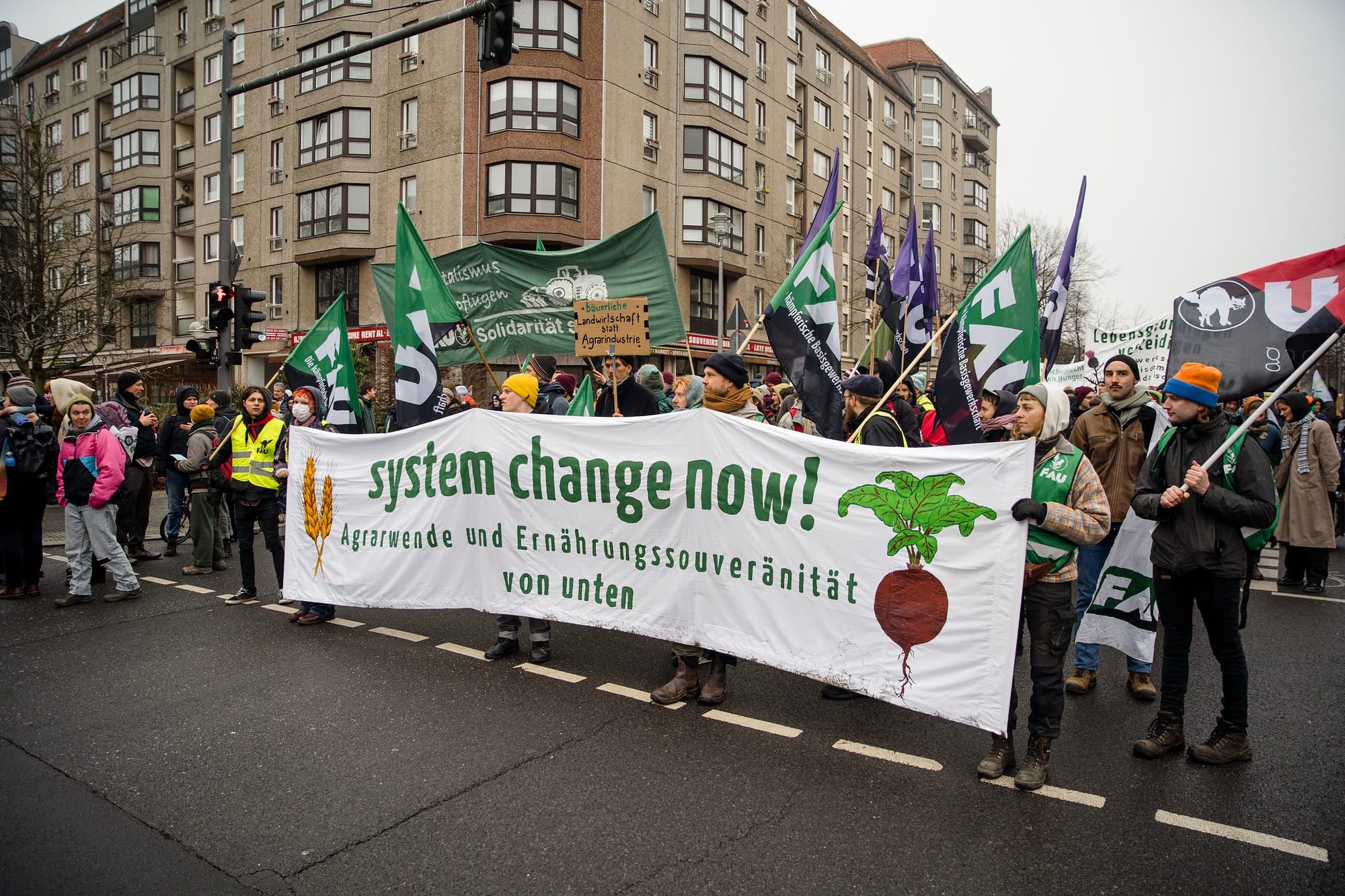
Farmers in Europe have long been angry about the conditions under which they work. Thousands took to the streets of Strasbourg last month to protest against a new trade deal with South America partially on the basis that cheap imports would affect their livelihoods. Many farmers, including regional farmer Gerdes, attended the annual Wir haben es satt! demonstration on January 17th in Berlin to demand legislation towards a better food system.
One of the key demands, Greve explained, is that agriculture should focus more on regional markets and not exports to international markets. Similarly, more money should be flowing into the hands of the farmers doing the actual work in the fields than the big businesses. “It’s very important that farmers start receiving more money,” he said. “They need more money so they can invest in more animal welfare, environmental protection, and biodiversity protection.”
 Jack McGovan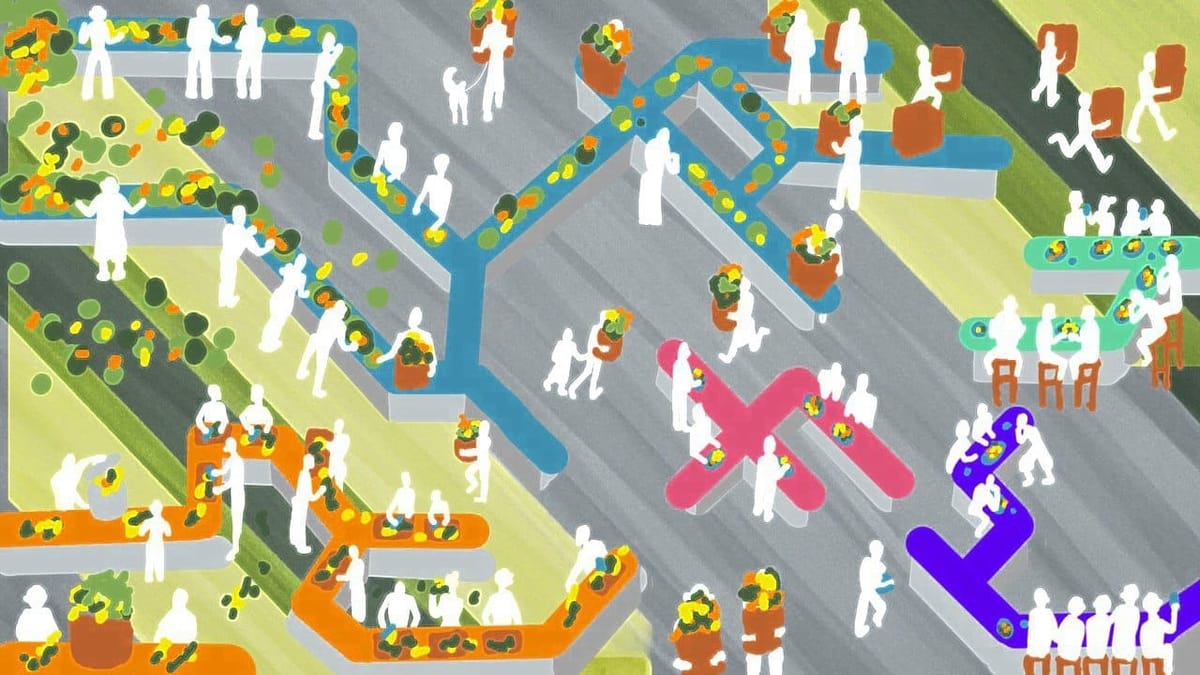
A report published in January found that more and more small- and medium-sized farms are dying out in Germany. Four supermarket chains—Edeka, Rewe, Aldi, and Lidl—control 88 percent of the German food retail market, meaning they’re able to dictate prices and drive down the earnings of producers. The consequence is that smaller businesses are squeezed out of the market.
Zoll added that there’s something fundamentally broken with our food system if a good harvest is considered a negative, and that we should try to reframe things. “Abundance, like in this potato story, shouldn't be a problem,” he said. “Actually, it should be considered a success.”
After watching Gerdes’ video and thinking about the impact of an influx of potatoes on regional farmers, Elms found it “unsettling” how quickly a good marketing campaign with a positive-sounding message could catch people, including herself. “There was this speediness that blocked most of us from thinking beyond the urgency of saving these potatoes,” she said, hoping that in the future she and others would view campaigns like 4000 Tonnen a little more critically.
Comments ()