
We all have the power to resist colonial narratives
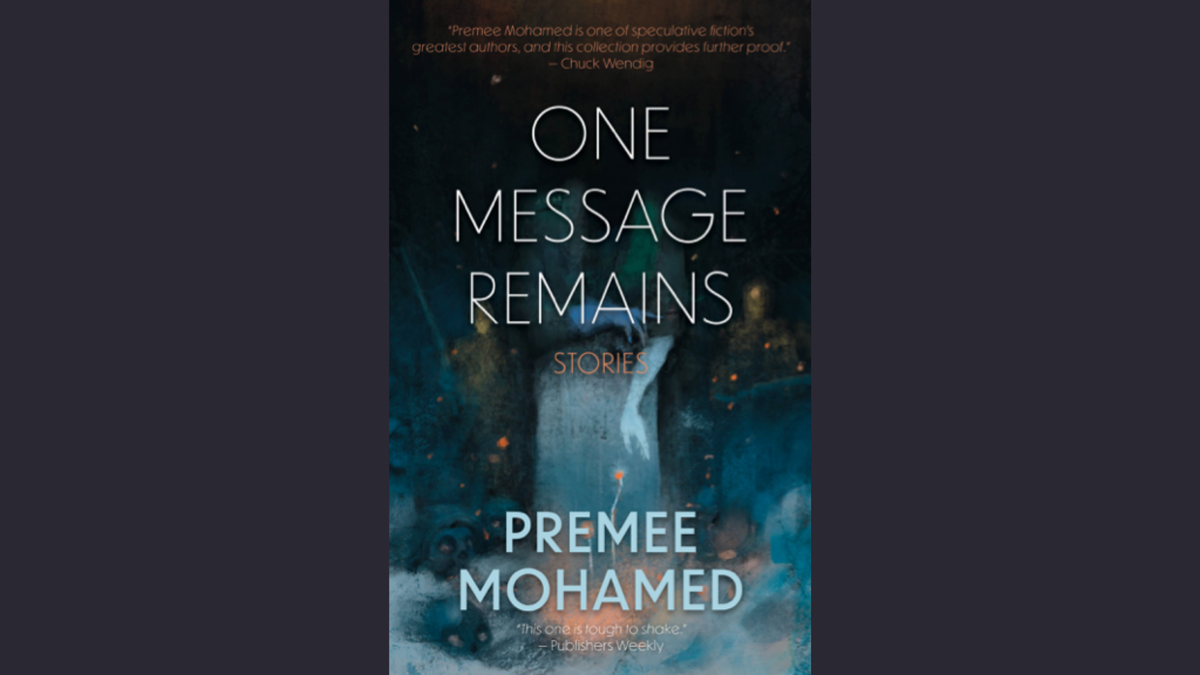
No matter whether you're inside or outside of the imperial core, we all have the power to resist colonialism—that's the core message of Premee Mohamed's One Message Remains.
Written by Libby Langhorn / Edited by Jack McGovan
When reading reviews of One Message Remains, a collection of short stories by speculative fiction writer par excellence Premee Mohamed, I was concerned that I had perhaps misunderstood the book completely. Many of the reviewers used similar words and themes, the general consensus being that these stories convey a haunted bleakness, ethereal and generally disturbing. My reaction, however, couldn’t have been more different. This book made me feel genuine hope and relief.
One Message Remains contains four short stories focussing on colonialism and imperialism within the fantasy empire of Treotan. In these works we encounter life within the imperial core of Treotan itself and on the ragged edges of the periphery, as the empire and the peoples and territories it seeks to subjugate are locked in struggle.
The way that Mohamed captures the thinking behind the idea of decolonialism—the process of dismantling the effects of colonialism and the systems of power and knowledge production that have shaped our world—is second to none. Abstract notions of Western hegemony and power structures are difficult to comprehend from a place within the system itself. The foreign world of One Message Remains affords us a distance to see that theory mapped onto the flesh of others.
 Jack McGovan
Mohamed presents us with the perspective of both the colonised and the coloniser, and it is through their eyes that we come to understand that this world is constructed through competing “truths”. In the Tretoan understanding of reality, there is no ambiguity, only hierarchies and processes. The agent of empire at his (for this is very much a gendered world) most perfected is presented as rigid and incapable of imagination. This is most evident when Mohamed’s Tretoan protagonists encounter Indigenous knowledge systems that resist Tretoan classification. Tretoan officials and army officers learn the subjugated societies as information on a page, and are left struggling to project their flattened world view onto a reality that defies their logic.
While this world may seem fantastical in its capacity for cruelty, it very much mirrors the horrors of our own present. We find that the Tretoans have appropriated a tradition from a society they almost eradicated; they carry out executions on gibbets made from the bones of victims of the empire. This exploitation of colonised bodies at the highest and most rarified levels of the imperial core is shocking and distressing and entirely plausible in our own reality. Would the story of dons at one of the most prestigious universities in the world drinking out of the skull of an enslaved woman at dinner parties strain your disbelief?
 Jack McGovan
You may be struggling to reconcile what I have written with my professed hope and relief. What is most subversive in One Message Remains is that Mohamed offers us a reprieve. She encourages us to consider the imperial self’s lack of capacity for empathy not as an immutable truth, but as something that can be resisted and challenged.
Repeatedly in these stories, our protagonists risk life and limb and beat seemingly astronomical odds to change and resist. A wizened old woman demonstrates an ability to bend an invading force to her will, and an imperial grandee chooses in a heartbeat to break with centuries of tradition. Across chasms of unimaginable destruction and suffering, one moment of feeling can light the touch paper of resistance. It is never too late to change course, and even the smallest actions in the most difficult circumstances count.
Comments ()