
Local municipalities are spearheading independence from US tech
Some municipalities are moving quickly to make Europe digitally independent from US tech, but civil initiatives are left to fill in the gaps where there is little political will.
This article is a collaboration between Sower and RESET.
Written by Jack McGovan / Edited by Lana O'Sullivan.
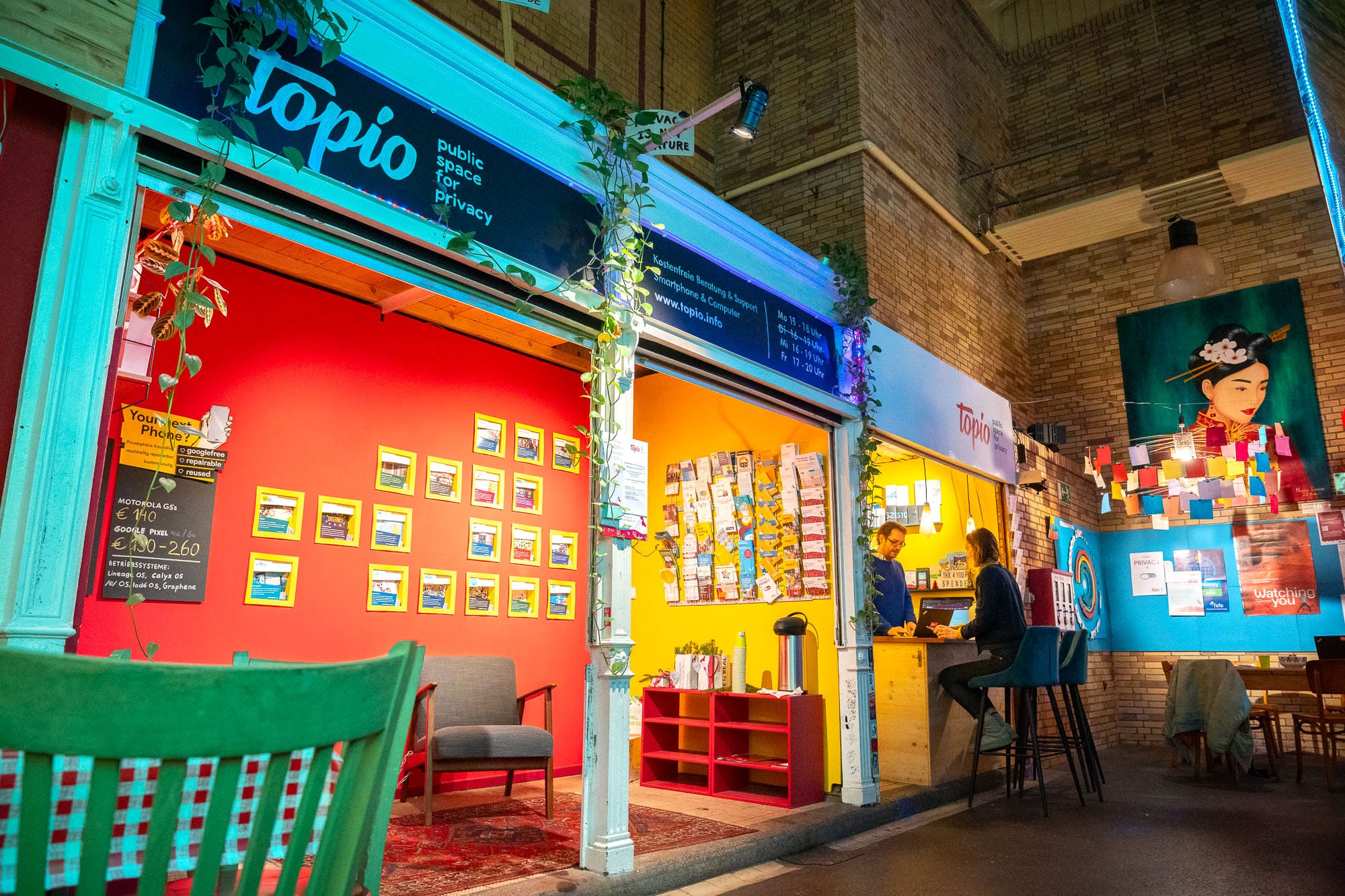
On the first warm day of the year, a group of six people huddled around a table in the back corner of the Arminiusmarkhalle in Berlin. While most of the stalls focused on fresh food or other gastronomic delights, the table was instead focused on technology. A few volunteers, there on behalf of the association Topio, answered visitors' questions about their laptops and assisted in transitioning the devices towards open source alternatives.
Roughly 20 people visit Topio’s stall each week, looking for help or to buy an open source device. While in the past most of their audience was averse to digital technologies, a larger cohort of younger and more digitally native people has started showing up. “We’ve noticed an increase in people who aren’t our typical audience since the [second] election of Trump,” explained Beatrijs Dikker, co-founder of Topio.
President Donald Trump’s second stint in the White House has highlighted the danger of European dependence on US tech. In May last year, Associated Press reported that the chief prosecutor of the International Criminal Court (ICC) lost access to his Microsoft email after sanctions imposed by Trump. Those sanctions were a jolt that has seemingly inspired more interest in European alternatives.
“We always joke that Trump is one of the main reasons for our job security,” said Gina Plat, interim lead of the Open Source Program Office for the Dutch Ministry of Interior. Plat said that digital sovereignty—the idea of Europe developing its own technology to reduce dependence on the US—is a hot topic, particularly in the Netherlands, where the ICC is located. Though, she added, she sees a strong European movement too.
“We’ve spent a billion euros marketing open source, but we couldn't do what Trump did in two months,” said Timo Väliharju, executive director of Open Source Finland. Before the incident with the ICC, Väliharju said conversations around open source in Finland focused on cost savings, ideology and developing a culture around open source. Now, they’re about security strategies, geopolitical risk and autonomy.
The EU Commission announced its Tech Sovereignty Package on 5th of June, including its open-source strategy. Intended to promote the use of European digital technology, support open source startups and strengthen the use of open source in public administration, the strategy has come under criticism. Although the EU has developed guidelines favouring European technology, for example, there is nothing binding in the package and the decision is left up to the discretion of member states.
Regional governments are more agile
A major success story of shifting towards open source is in the German state of Schleswig-Holstein. There, nearly 80 percent of workstations in public administration have been converted to Libre Office, an open source alternative to Microsoft Office. The state has saved 15 million euros in licensing fees, and after accounting for switching costs and other expenses, nine million euros were reinvested in the local open source ecosystem.
“We’re aware of our role as pioneers, but we didn’t start last week—we had a head start,” said Alexander Rosenthal, project leader at DigitalHub.SH, an independent project put in place by the municipal digital ministry to help realise the state’s digital strategy. Rosenthal said the work started five years ago, and that the transition was made possible by a healthy open source ecosystem, the advocacy of digital minister Dirk Schrödter and a supportive cabinet.
DigitalHub.SH is already in conversation with other states in Germany, as well as interested international parties both inside and outside of Europe. For example, they recently had delegates visit from the Netherlands and Austria. He urged others to just get started on the transition, rather than worry about edge cases. Similarly, he hammered home the importance of building a narrative and encouraging people to switch; technological changes are only one part of the transition.
Schleswig-Holstein isn't, however, the only success story in Europe. The administration of the Spanish region of Valencia has already installed Libre Office on 120,000 of its computers, and the Portuguese town of Seixal completed their migration to the open source software in 2019. What makes Schleswig-Holstein stand out, perhaps, is its size; it’s far bigger than both of those regions put together. The perfect size for quick impact, according to Rosenthal: “We’re big enough that we can make a difference, but at the same time small enough that we know each other”.
The smaller size of local governments is something Plat also sees as a benefit in the context of the Netherlands. “The municipalities are so much more agile and it's so much easier to get things done and started, whereas the Dutch government is like an oil tanker,” she said. “It takes forever for it to change course.”
Amsterdam recently published a multi-year strategy for making the municipality fully digitally autonomous by 2035, and the regional council of Friuli-Venezia Giulia, Italy, voted for a transition to open source software at the end of last year.
Italo Vignoli, marketing and PR manager for Libre Office, agreed with the assessment that there is more movement to Libre Office on a local level, with exceptions. Danish hospitals, he said, moved to the software around ten years ago. “At the moment, there is a stronger movement in the direction of digital sovereignty in Europe than in other parts of the world,” he said.
Civil initiatives fill in where there is little political will
Although many municipalities are moving towards open source software, not all of them are. In Berlin, the homeplace of Topio, the local government published an open source strategy this year. However, there’s scepticism about whether it will actually be properly implemented. “Especially in Berlin, there’s no open source culture in the public administration,” said Tom Jennissen, lawyer and speaker for the association Digitale Gesellschaft (Digital Society).
Dikker said that civil initiatives like Topio become more important in times when politics isn’t pushing things forward. “We’re a laboratory for finding out what works and what doesn’t,” she said. “We hear from politicians that it’s important for them and that [open source] is supported by civil initiatives as well. They need a mandate from the public to legitimise their work.”
The idea of Digital Independence Day has been gaining traction in Germany, with civil organisations across the country running events on the first Sunday of every month. The intention behind the events is to promote independence from all big companies, whether in the US, China or Europe. People receive advice on switching to open source alternatives and have an opportunity to discuss potential solutions to problems that go beyond an individual device. There are currently 1490 events listed on the Digital Independence Day website, the majority in Germany, including one hosted by Topio.
 Jack McGovan
Jochim Selzer, speaker for hacker association Chaos Computer Club, has hosted multiple Digital Independence Days. He said that citizens and citizen initiatives can apply social and political pressure to change systems, but that ultimately they wouldn’t be able to do all of the work. “I want to stay independent from big companies, and I want more people to be able to do that,” he said. “Most importantly, social networks and messengers are things that you can't decide on your own to change.”
More funding and support needed
Despite the strides taken in certain parts of Europe, there is still a long way to go towards becoming digitally sovereign. The Digital Sovereignty Index, published by open source platform Nextcloud, found that the vast majority of countries on the continent had a score of less than 20 out of 100.
Väliharju suggests that, in Finland at least, there’s a sense of hope that things will return to normal after the Trump presidency. But he thinks the trust has already been broken. What is needed instead is political courage and stronger investments. “What we really need to do is try to fund the sustainability of those open source projects that we have in Europe,” he said.
Plat sees things similarly. “The whole reason that we got captured by big US tech is because they looked after us so much; they took care of everything, we just handed them all our money and all of our technology,” she said. “Now is the time to look towards these alternatives and to build up skills to be able to manage them ourselves a bit better.”
Right now, Dikker said that open source is to be found in many informal industries, with individuals responsible for security features for large swathes of the world. In order for open source to be a serious challenge to big tech corporations, it needs to become a bit more institutionalised. “Critical infrastructure can’t be dependent on a few people: we need good working conditions and well-paid jobs,” she said.
Comments ()